
When the Going Gets Weird ....
or Surprise, Stupefaction, and the Weirdness in Between


I know and have known enough weird people in my life — and I’ve encountered enough general weirdness — to believe I’m well-versed in and pretty adept at handling weirdness. I’m also exceedingly naïve, which is what leads me to believe I’m well-versed in and pretty adept at handling weirdness. Because of that naïveté, I still experience something between surprise and stupefaction when I meet people or encounter things so weird I’d never have imagined them in a million years.
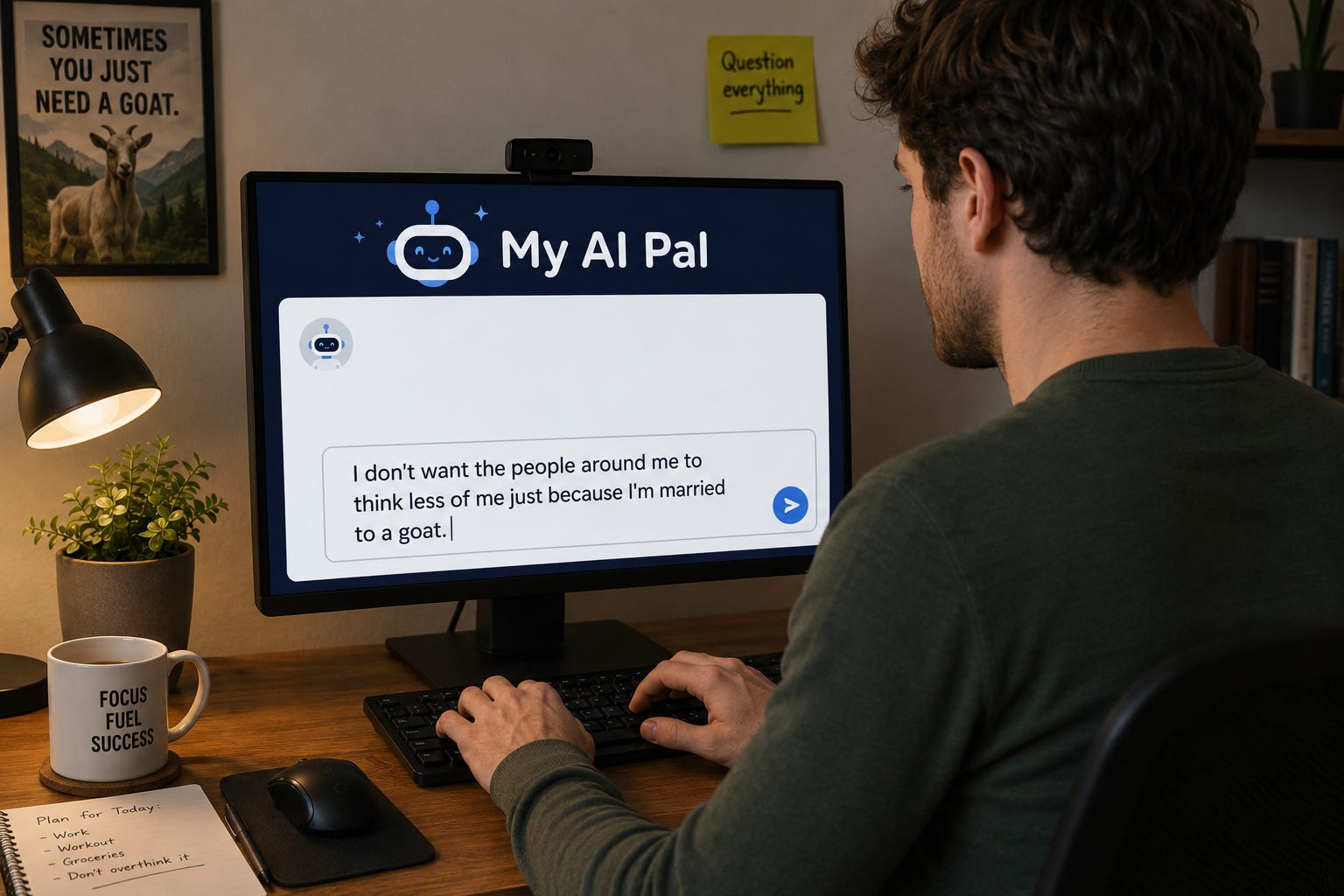
Case in point: I recently read a headline in an online publication called, Silicon Canals, which describes itself as an independent publication covering global innovation ecosystems (it apparently covers jargon, too), that said this, “If you find yourself telling an AI things you’d never say to your partner, your therapist, or your best friend, you’re not broken — you’re just exhausted from performing”. I probably could have hovered comfortably somewhere between surprise and shock if I hadn’t clicked through to the article, which was written by a woman named Nato Lagidze. But I did click. And thanks to my naïveté, I didn’t hover for long:
When you consistently signal high competence, the people around you take the signal at face value … [but not] in chat windows. A growing body of research on AI disclosure points to the same pattern from the other direction: people are telling chatbots the things they will not say to anyone who knows them. The two findings braid together into something specific. The audience that needs you to be fine is also the audience you cannot be honest with. And so, at some point, you opened a chat window and typed something you hadn’t said to anyone … the people around you have been quietly conscripted into an audience, and you have been performing for them so long that the only place left to be a person is somewhere no person is.
It seems to me, weirdness notwithstanding, there are three things to consider here:
Nato Lagidze and her ilk may need a better class of people around them.
The people around Nato Lagize and her ilk may need a better class of people around them.
Nato Lagidze and her ilk probably shouldn’t shy away from counseling.
Nato Lagidze and her ilk definitely should stay away from computers.
Regardless of whether they get a better class of people around them, regardless of what kinds of counseling help they may or may not seek, and even if they do stay away from computers, I’m not sure I’d consider people who talk privately to their AI Pals to consistently signal high competence. I’d be more inclined to go with high paranoia, low self-esteem, or acute social ineptness.
When the going gets weird, the weird turn pro. (Hunter S. Thompson)
The Other Side of the Coin
I also know and have known people who spend a good deal of time talking about authenticity, about being their real and true selves in social, cultural, and professional contexts. The only people who could adhere to such absolutism would have to be completely incapable of reading defenses (to use a sports analogy), deliberately uncaring, moderately sociopathic, or full-on psychopathic. Otherwise they’d call mental and behavioral audibles (to use another sports analogy) depending on whom they’re with and the contexts they’re in.
Another case-in-point. I was once invited to a commemorative event of the Order Sons and Daughters of Italy in America® (OSDIA). It was held at a local chapter in Wethersfield, Connecticut.
As a card-carrying Mick, I was aware of the history of some friction between Irish and Italian immigrants to the United States. More specifically, Italians competed with the already-established Irish for low-skilled jobs and housing. The Irish often resented Italians for accepting lower wages. This competitive resentment led to street brawls, political clashes, mutual distrust, and a lot of swearing and spitting.
While things have been pretty well patched up since the mid-19th century, I was nevertheless determined to be utterly authentic, my real and true self, at the event. So, after several rounds of pre-meal drinks (Aperol Spritz and Negroni) and post-meal drinks (Limoncello, Sambuca, and Amaro), I told a joke about accidentally walking into a room full of deaf Italians playing Charades. After narrowly escaping with my life, I determined the authentic, real and true self thing wasn’t all it was cracked up to be. And in some contexts, it could be alarmingly hazardous to your health.
That lesson leads me to wonder what the authenticity crowd would make of Nato Lagidze’s article. Because it criticizes performative behavior, which is plentiful in being one’s authentic, real and true self — and because it encourages interacting with a non-person that won’t appreciate your performance or your authenticity — I’d imagine it would inspire the ire of groups like ANTI (Authenticity Nuts Turning Indignant), MANIA (Many Anomalies Noted in Authenticity), GNAT (Generally Nice Authentic Types), FLAP (Fully Legitimate Authentic People), GLAD (Genuinely Licensed Authentic Dudes), ANGINA (Authenticity Nerds Going Insane Need Antidepressants), and APESHIT (Authentic People Examining Suspicious Hiccups in Trustworthiness).

Weirdness by Any Other Name ….
I was once at a birthday party, thrown by the authentic, real, and true mother of a friend named Jayne. There was utter bedlam in the house, with chaotic weirdness being exhibited loudly and animatedly in every room. As I worked my way through the living room, I encountered a man named Frank. Jayne had befriended Frank in graduate school. Frank was a biker and looked every inch the part — burly build, leather vest, wall-to-wall tattoos, and a long, red beard. He was sitting quietly on an ottoman in the middle of the room, smoking a cigarette, an oasis of calm in the storm.
I walked over to him and said, “Frank, you look like you’re doing alright.”
Frank took a long, peaceful drag of his cigarette. And as he was exhaling the smoke, he looked slowly and serenely up at me and said, “I adapt to all life forms.”
Sadly, Frank’s smoking habit got him before old age did. But he understood contextual authenticity. He didn’t need to share his deepest, darkest, non-performative secrets with AI. He understood the only necessary secrets are acceptance and comfort in his skin. And he knew how rare those secrets are.
We need more Franks in the world.
I miss him.
Nice one! Nato Lagidze and her ilk will now consult their therapists, their friends, and, unfortunately, their computers.
I must hear this Italian joke. Sounds like a brilliant premise. Please do tell 🤣