
Spin the Bottles
or The Kiss of Insolvency


I recently wrote a post about the state of Connecticut’s nickel-per-nip program, under which the state adds five cents to each little bottle of booze Connecticut’s drivers drink in their cars and throw out their windows as they’re driving. The money is intended to go back to the towns in which the little bottles are sold to help clean up the litter from the little bottles that get thrown out of car windows. The program is otherwise known as Nips for Nuts or The Vicious Circle of Unintended Consequences.
The story that inspired that post ran in a publication called CT Mirror. When reading the story, it occurred to me people in Connecticut are much like vampires; that is, when they look in mirrors, they cast no reflections. And that notion was reinforced when I read another article in CT Mirror, this one entitled, “CT bottle bill concerns prompt legislation that could return rate to 5¢”.
A bill that could decrease Connecticut’s bottle redemption rate from 10 cents to 5 cents passed out of the Finance, Revenue, and Bonding committee … Senate Bill 516 would set the rate at 5 cents if the bottle redemption rate —the number of containers returned divided by the number sold — of the state, or any distributor, surpasses 100% in 2026. Recently, Connecticut’s redemption rate hit 97%. “Some pretty smart people outside the state of Connecticut have figured out how to maybe make a living, maybe a pretty good living, on redeeming bottles and cans from outside of Connecticut, bringing them into the state, where they paid 5 cents outside of Connecticut,” said Sen. John Fonfara, D-Hartford, co-chair of the Finance Committee.
I’m a little flabbergasted that anyone who drafted the bill — or who voted for the people who drafted the bill — believe they can concoct a mathematical equation that look like this: If R represents the number of containers returned and S represents the number sold, the equation is: Quotient = R/S. But I give Senator Fonfara credit for acknowledging the reality that the smart people live outside of Connecticut.
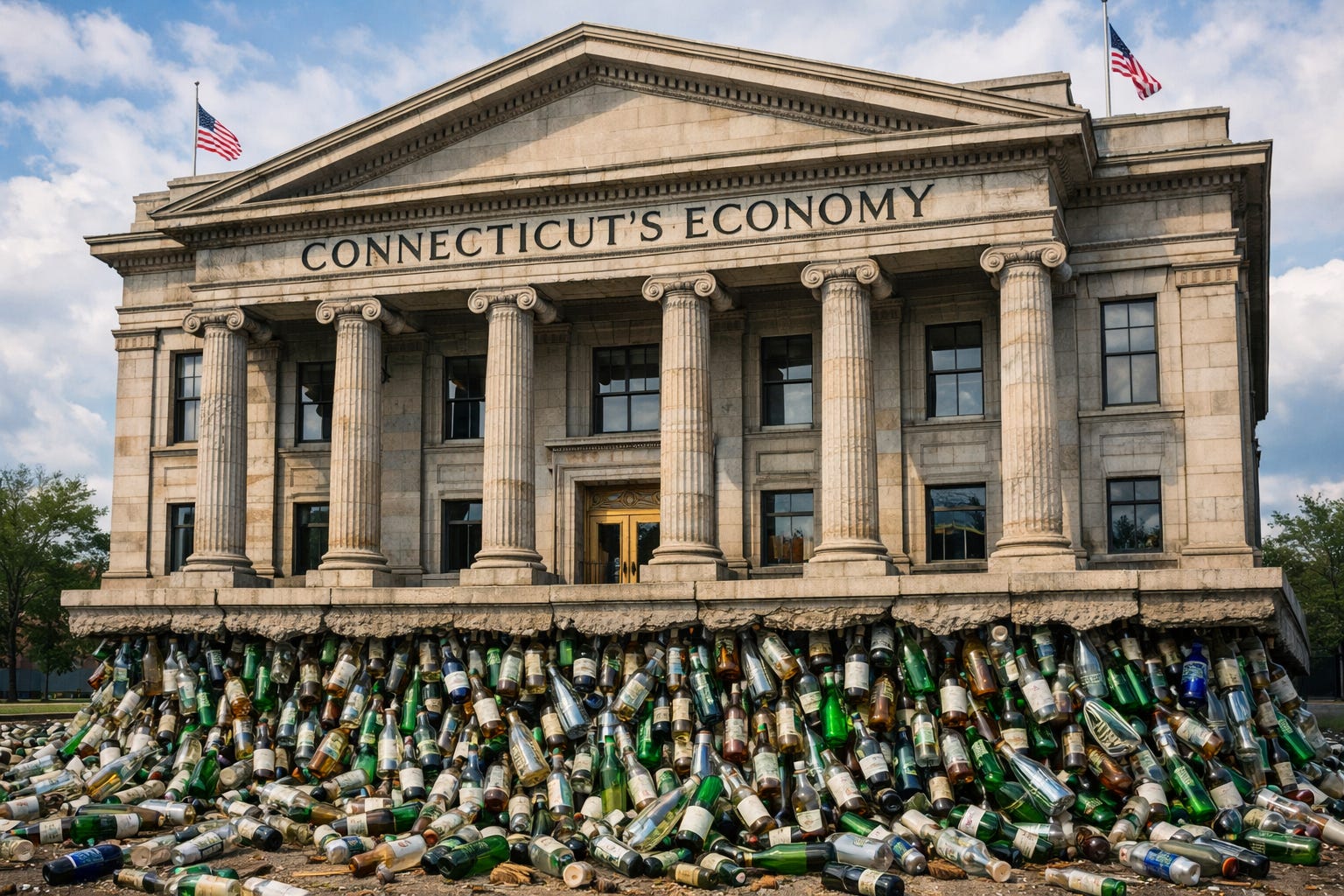
As just one example of why Connecticut is considering changing one of its nicknames from The Land of Steady Habits to The Land of Mental Giants, its beverage container redemption rate was raised from five cents to ten cents as part of SB 1037, which was signed into law by Uncle Ned in June of 2021 to modernize [emphasis mine] the state’s Beverage Container Deposit & Redemption Law. That’s because in a state that’s leaking money and people like a hemophilic on heparin, few things are as important as modernizing the redemption rate for its bottles and cans.
Author’s Note: With apologies for repeating myself, I remind you yet again you can go to the home page for this account and type Connecticut in the search to get an understanding of the extent to which Connecticut is politically and economically FUBAR.
Off Their Meds
One of the steadiest habits in the land of them is the incorrigible conviction that we have to mess with absolutely everything. If there were a singe, universally recognized clinical term or mental-health condition for the psychological phenomenon that compels people, particularly in government, to mess with or interfere in everything — whether it’s tweaking statutes, systems, processes, objects, situations, or other people’s affairs — Connecticut would be the land of that. And Connecticut would be mentioned by name in the DSM-5-TR. But that, apparently, will have to wait for the DSM-6. In the meantime, we’re stuck with trying to identify its component elements.
The closest matches are:
Fixer Mentality (FM, not be confused with radio) or Chronic Compulsive Fixing (CCF) is a common trait. It consists of a strong drive to fix things, especially if they ain’t broke. It stems from feelings of anxiety, a need for control, perfectionism, inadequacy, inferiority, or a critical awareness of ineptitude that renders one incapable of doing anything constructive or meaningful. In Connecticut, it appears to compel people to run for government at some level or to take administrative positions that let them monkey with things that are better off left alone.
Need for Control (NFC) or Control Freak Syndrome (CFS) is a psychological condition that compels people to believe they have to direct or alter everything to protect them from their own senses of — or to attempt to prevent — uncertainty or chaos. NFC and CFS appear frequently in conjunction with anxiety disorders that make uncertainty feel intolerable, prompting the constant interference or micromanaging that characterizes Connecticut government.
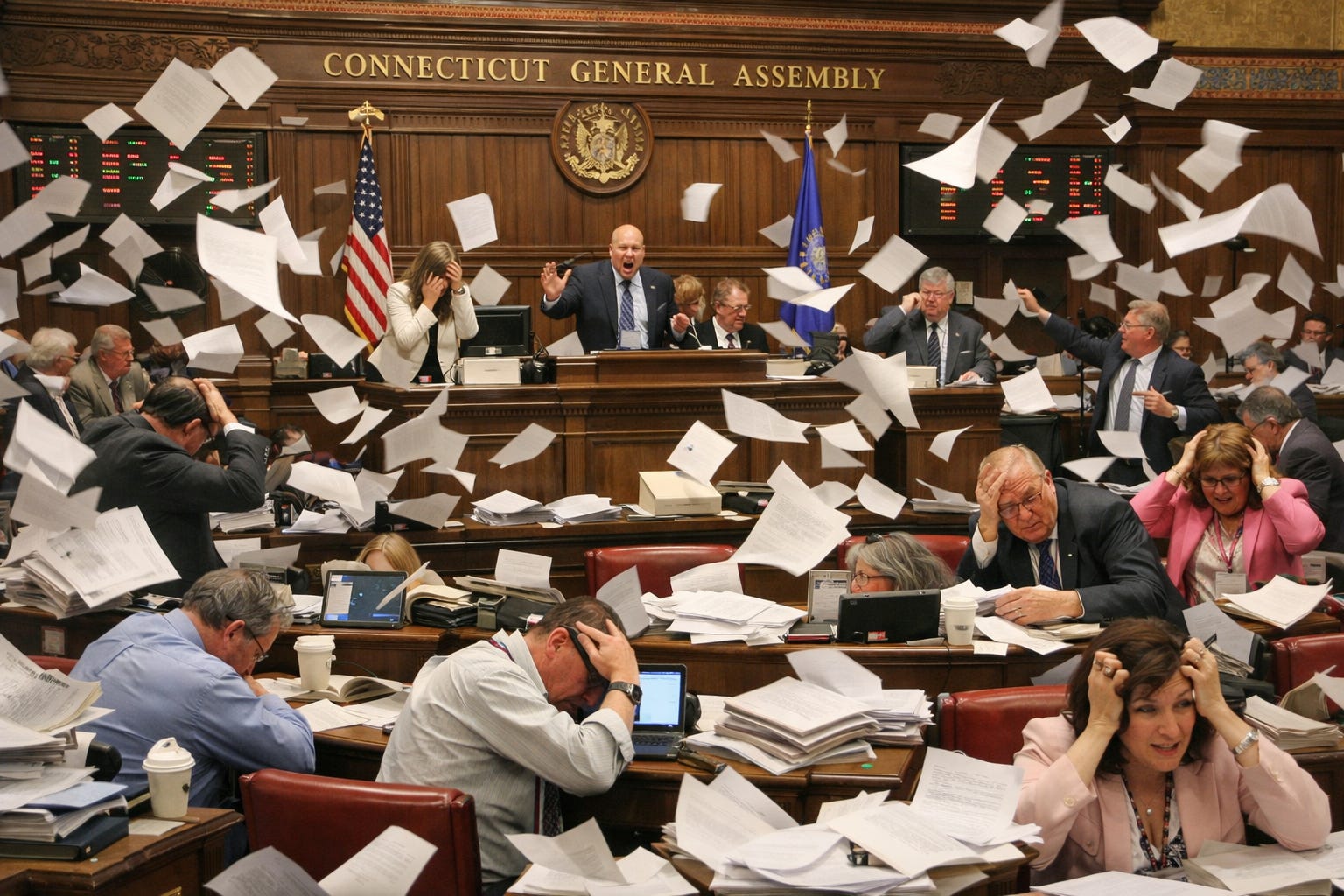
Meddling Behavior (MB) or Incessant Fuckery (IF) are clinical terms for a condition that causes those with the condition to engage in habitual interference in others’ affairs. It’s characterized by an abject absence of boundaries. The formal records of the Connecticut General Assembly are rife with instances of MB or IF, disguised as good intentions and unrealistic promises..
Obsessive-Compulsive Disorder (OCD) isn’t always associated with chronic urges to mess with everything. It can feel more like intrusive thoughts that drive people to repetitive actions like constantly adjusting, reorganizing, or intervening in things to reduce anxiety. Common compulsions include ordering or arranging things until they feel just right (which never happens), or checking and intervening excessively to make things perfect (which never happens). Typical manifestations of this condition include checking locks to make sure they’re secure, checking stoves or ovens to make sure they’re shut off, or constant hand-washing; although, in the case of Connecticut and its politicians, that manifests as washing their hands of responsibility for the consequences of their FM, CCF, NFC, CFS, MB, IF, and OCD.
Consistency ≠ Steadiness
I don’t mean to suggest this is like a universal truth or anything. But you can be fairly certain things have a habit of going sideways in your state if one of its nicknames is Corrupticut. We’ve had more issues with relatively trivial matters like ethical infractions, fiscal mismanagement, political malfeasance, and a staggering lack of accountability than fake nutmegs.
Here’s the short list, incomplete list, in reverse chronological order:
Former member of the Connecticut House of Representatives, Michael DiMassa (2017-2021), was arrested on federal wire fraud charges related to the alleged misappropriation of $636,783 in federal COVID-19 relief funds to gamble at Mohegan Sun Casino. He ultimately stole more than $1.2 million in pandemic aid.
Former Governor John Rowland (1995–2004) resigned amid a federal corruption investigation involving gifts, favors, and contracts from state contractors and developers. He pled guilty to conspiracy to commit honest services fraud, mail fraud, and tax fraud. He served prison time and later faced additional charges related to his post-gubernatorial activities.
Former State Treasurer, Paul Silvester, pled guilty to corruption charges in the late 1990s and early 2000s for shady investment deals.
Mayor, Joe Ganim of Bridgeport (1991 to 2003) went away for racketeering and corruption and was re-elected after prison. (?!)
Former Waterbury Mayor, Philip Giordano (1996-2001), went away on corruption-related charges, including child sex abuse.
Former Waterbury Mayor, Joseph Santopietro, (1986-1991) was convicted of conspiracy, embezzlement, bank fraud, and tax evasion
Former Waterbury Mayor, Frank Hayes (1930-1939), was also convicted of defrauding the city.
More recently, governors like Dannel Malloy and Uncle Ned have acted like combinations of Alfred E. Newman and Sgt. Schulz.
We can’t even manage five and ten cent deposits on bottles. That’s why the Connecticut State Motto is, “Come for the Nips. Leave for the Corruption.”
And it’s why the State Sport isn’t basketball. It’s Spin the Bottle.
I've long held the belief that most politicians arrive in office fully equipped with little conscience and big plans. Indeed, I think that at some point, politicians in general decide that while they are busy creating endless entitlements programs for the disadvantaged, they might as well create one big-ass entitlement program for themselves — one that grants them unlimited rights to engage in the corruption required to satisfy their inherent greed and addiction to control. And as I read your articles and feel my own head nodding along in disgust, I wonder just when it was that our government, originally forged by founders deeply committed to integrity in all aspects of governing, foundered, instead becoming a source of personal aggrandizement and inexplicable wealth. It's beyond sad. It's a malignancy for which we seem to have no cure.