
Perpetual SNAFU
or Our Cup Runneth Empty


I’ve discovered a new diet plan. This is how it works: Read anything at all about Connecticut’s economy first thing in the morning, and you won’t feel like eating all day. Since breakfast is purported to be the most important meal of the day, try this headline on for size: “CT legislature adopts $28B budget with big aid for towns, childcare”. After reading that and the story that followed, I honked everything I’d eaten the past week. Here’s a taste:
The General Assembly adopted a $28.1 billion state budget Saturday that orders major new investments in municipal aid and affordable childcare and restructures Connecticut’s tax on hospitals to leverage more federal aid and assist the industry. Legislators did not include Gov. Ned Lamont’s proposal for a $200-per-person tax rebate this October nor any of the major tax-cutting proposals offered by either party … Lawmakers also added funds for nonprofit social service agencies and established a universal free breakfast program in Connecticut schools.
Major new investments. I love that. In case you’re new to politics in general or Connecticut in particular, investments is what Democrats call the tax dollars — your tax dollars — they spend to buy votes. And that’s why Democrats call tax dollars — your tax dollars — revenue. But revenue is the income a business generates over a specific period, before subtracting any costs or expenses — generated from operational activities like selling goods, services, and other things for which people choose to pay. Governments generate nothing. Tax is the money taken from you whether you like it or not.
Oh. I almost forgot: Connecticut is a right-to-work state. That means you have a right to work in any of the unions Uncle Ned promises to give raises to every year with your revenue tax dollars. But you need to be lucky or to know some pretty heavy hitters to get one of those sweet gigs.
And while Connecticut lawmakers (Democrats) are considering a bill that would exempt all course syllabi at the state colleges and universities, from requests for public viewing under the Freedom of Information Act (FOIA), the new budget will be codified in a required course to be offered at all state colleges and universities. The course is called How to Win Re-Election 101. Stealing a line from Sanford and Son, the course will also be known as Promise ‘Em the Elevator but Give ‘Em the Shaft.
As with anything else, the real stomach-turning effect of that story is best experienced in context, specifically this context:
Approximately $26.5 billion in state taxes were collected by the Connecticut Department of Revenue Services for the fiscal year ending June 30, 2025, from income tax collections, including from capital gains and business income. Per-capita state and local tax burdens are among the highest in the U.S.
The image below is the SHARP COMPET VX-2126A calculator I’ve had since my corporate days, which ended in June of 1995. It’s old school, not high tech:
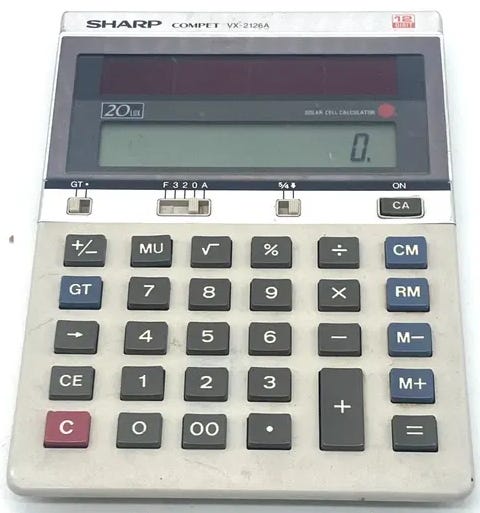
I suspect none of the Democrats in the Connecticut State Legislature has one of these or anything like it, anything capable of performing the same functions. I suspect that because, using my trusty SHARP COMPET VX-2126A, I was able to calculate this:
$26.5 billion - $28.1 billion = minus $1.6 billion
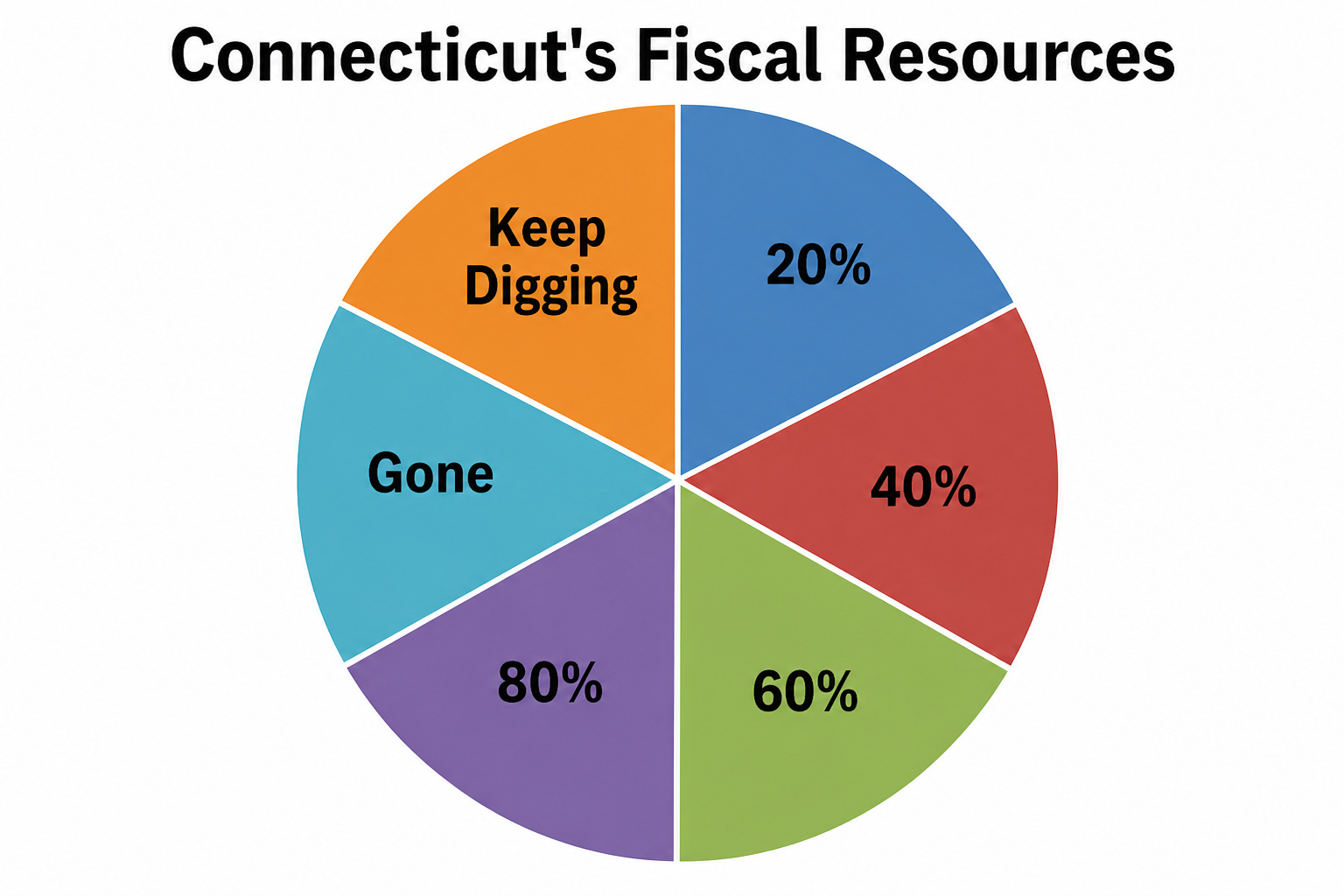
In other words, nothing has even happened yet in fiscal 2026, and we’re already looking at being $1.6 billion in the hole. That’s the kind of math only a Democrat could love. Or to put it another way, the pie is gone, but the Democrats keep promising slices.
On Balance
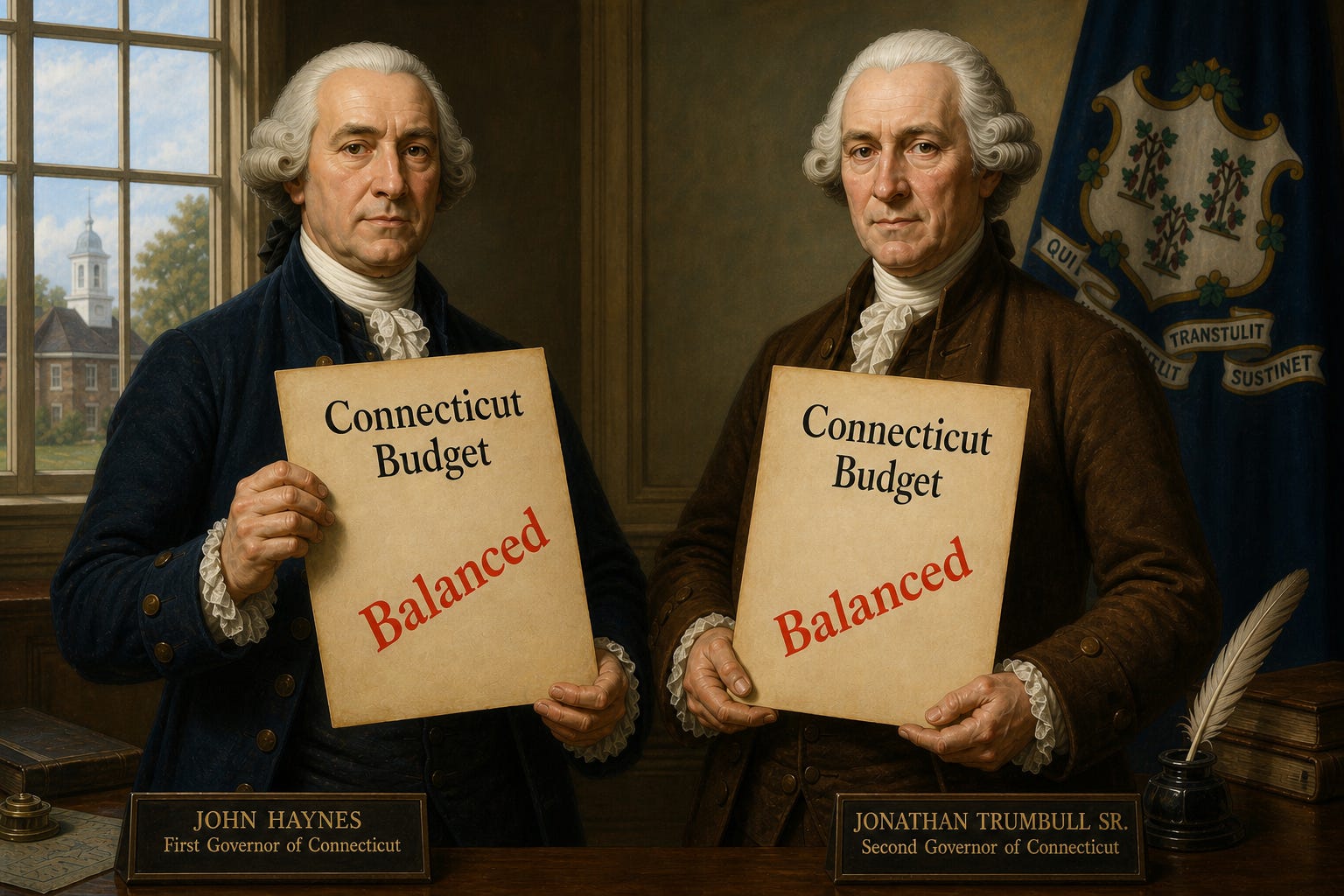
Depending on how you want to score it, Connecticut has only had a legitimately balanced budget twice in its history. While recent Democrat administrations have claimed surpluses at the end of various fiscal years, those surpluses are also referred to as funny money, phony mazuma, or smoke blown up people’s asses.
The first governor to balance Connecticut’s budget was John Haynes, who was the first governor of the Connecticut Colony. He was elected on April 11, 1639, under the Fundamental Orders of Connecticut (often considered one of the first written constitutions in the American colonies). He had previously served as governor of the Massachusetts Bay Colony from 1635 to 1636 but left there because he had difficulties getting along with the Kennedys. He led a group of settlers to the Connecticut River in 1636, changing the name from the Massachusetts River to spite the Kennedys.
Born in Essex, England, Haynes was instrumental in forming the New England Confederation in 1643 for collective defense. He helped negotiate cash settlements with Native American tribes and Dutch settlers and was a key figure in the founding of Hartford (originally Heartford until it was discovered the city didn’t have one). And since he was playing with King George’s money, he decided he could spread the wealth and call the budget balanced.
The second governor to balance the budget was Jonathan Trumbull Sr. He served as governor of the Colony of Connecticut from 1769 to 1776, then first governor of the independent State of Connecticut from 1776 to 1784. He was the only one of the 13 colonial governors to support the American Revolution. He encouraged anti-Loyalist measures (such as barring Loyalists from militia officer roles), turned Connecticut into the unofficial Provisions State, supplying a huge portion of the Continental Army’s manpower, food, clothing, shoes, munitions, livestock, lumber, cigarettes, booze, comic books, and bubble gum. And he rode from Hartford to Boston on April 18, 1775, to wake up Paul Revere, despite the presence of the Kennedys. His ride from Hartford was about a hundred miles, making it almost 83 miles longer than Revere’s ride of 17-and-a-half miles from Boston to Lexington.
Trumbull balanced the budget by limiting paper money issuance (replacing bills with wooden nickels), raising taxes, and legalizing gambling, prostitution, tiddlywinks. He also served as Paymaster General for the Continental Army’s Northern Department in 1778. Rumors of his cooking the books have remained unconfirmed.
On balance (no pun intended), we’ve been sucking wind for 242 years.
Oh, Well
Since Democrats don’t study, heed, or believe in history (suckers are always in the present and Utopia is always in the future), it’s not likely Haynes or Trumbull will be role models for them, unless Trumbull did, indeed, cook the continental army’s books. But that’s not likely because if he did, he’d be hailed as a hero by Democrats. They’d all have his name or his likeness tattooed on them somewhere, and they’d coin this phrase as their Party motto:
There comes a time in every man’s life when he must take the Trumbull by the horns and throw it.
And since a majority of Connecticut’s voters aren’t likely to find their lost marbles before (or after) November, fiscal year 2026 will bring us more of same — more promises, more spending, deeper holes, and more kamikaze economics.
The deep shit we’re in is the price we pay for not caring or paying attention.