
Let Me Get This Strait
or Nice Doggie

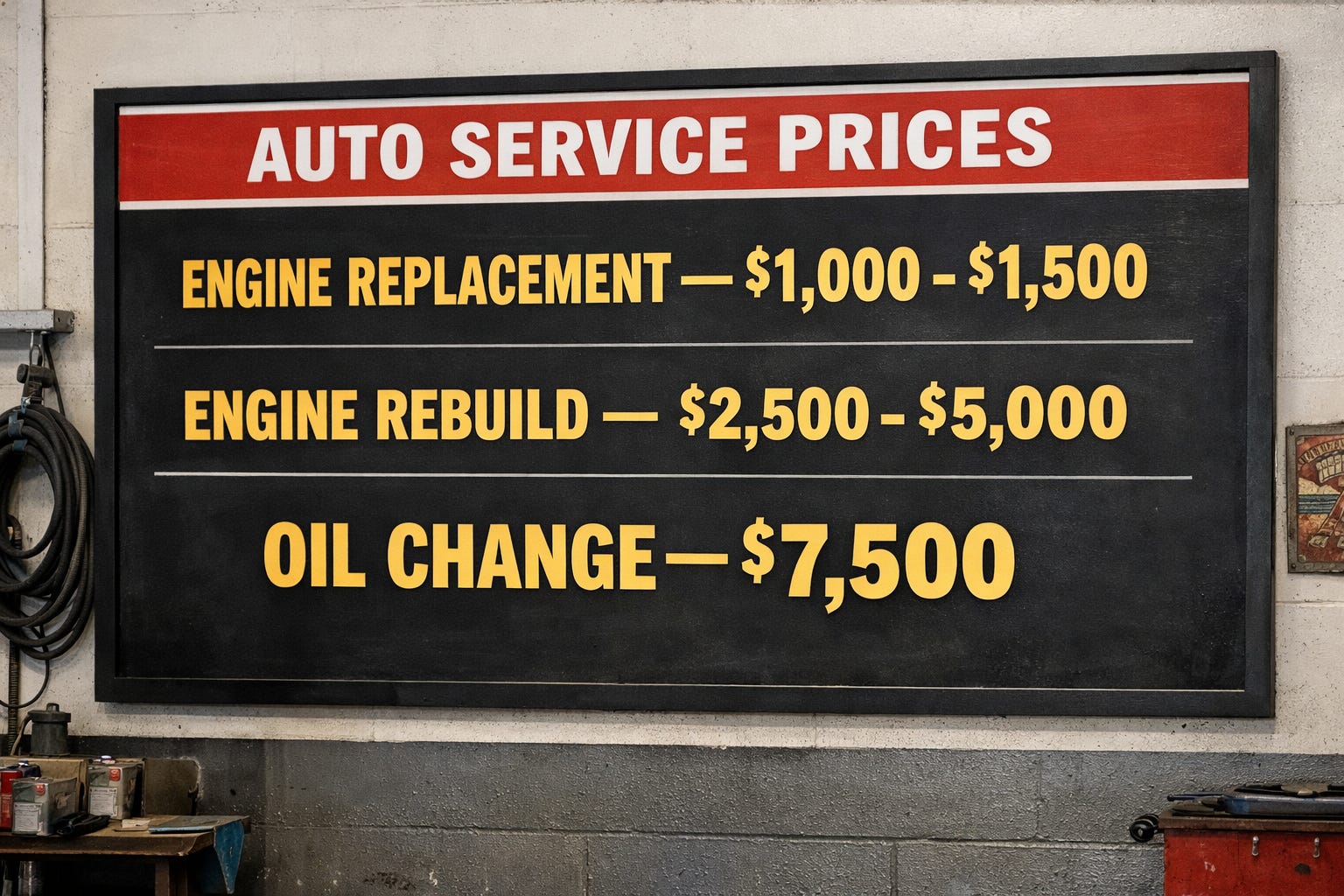
I drive a 2022 Chevrolet Trailblazer RS. I bought it used in January of 2025 during a severe attack of frugality. Since I drive fewer than 5,000 miles a year, it was only recently due for an oil change. When I stopped in to a local service station to make an appointment, I saw the sign above on the wall. When I recovered from the shock, I asked the mechanic on duty why an oil change was so expensive. He said something about a problem in the Middle East.
Without scheduling the oil change, I drove home, got on the internet, and looked up what was going on in the Middle East. It seems the United States and Israel decided to attack Iran for one of two reasons:
To stop years of escalating tension; to mitigate threats from Iran’s nuclear program and ballistic missile capabilities; to respond to violations of nuclear agreements; to eliminate threats from the terrorist Iranian regime after diplomacy failed; to stop Iran’s sponsorship of proxy groups attacking US and Israeli interests; and to ensure unanimous participation in UMEC (the United Middle East Choir), which suffers from a chronic lack of tenors.
To piss off Democrats.
Because Democrats get pissed at anything President Trump does, especially if it works, they can’t see the forest because they’re preoccupied with what they think they see in the bark on the trees. “The US-Israeli strategy against Iran is working. Here is why” is one of the things they’ve missed:
When you look at what has actually happened to Iran’s principal instruments of power – its ballistic missile arsenal, its nuclear infrastructure, its air defences, its navy and its proxy command architecture – the picture is not one of US failure. It is one of systematic, phased degradation of a threat that previous administrations allowed to grow for four decades.
I also found a Substack newsletter from Michael Liebreich, a leading global expert on clean energy, transportation, smart infrastructure, technology, climate finance, and sustainable development; Chairman and CEO of Liebreich Associates, a consultancy providing advisory services and speaking engagements on the net-zero transition; co-managing partner of EcoPragma Capital, a growth equity investor focused on companies driving the net-zero transition; and a perennial loser in ISB Spelling Bee International. The newsletter was entitled, “Thoughts on the Straight of Hormuz crisis”. The title was later changed, per this note at the bottom: “Updated 12 March 2026, correcting spelling of Strait of Hormuz, and adding a few bits and pieces.” But the URL wasn’t, as you’ll see when click on the hyperlink to the newsletter above.
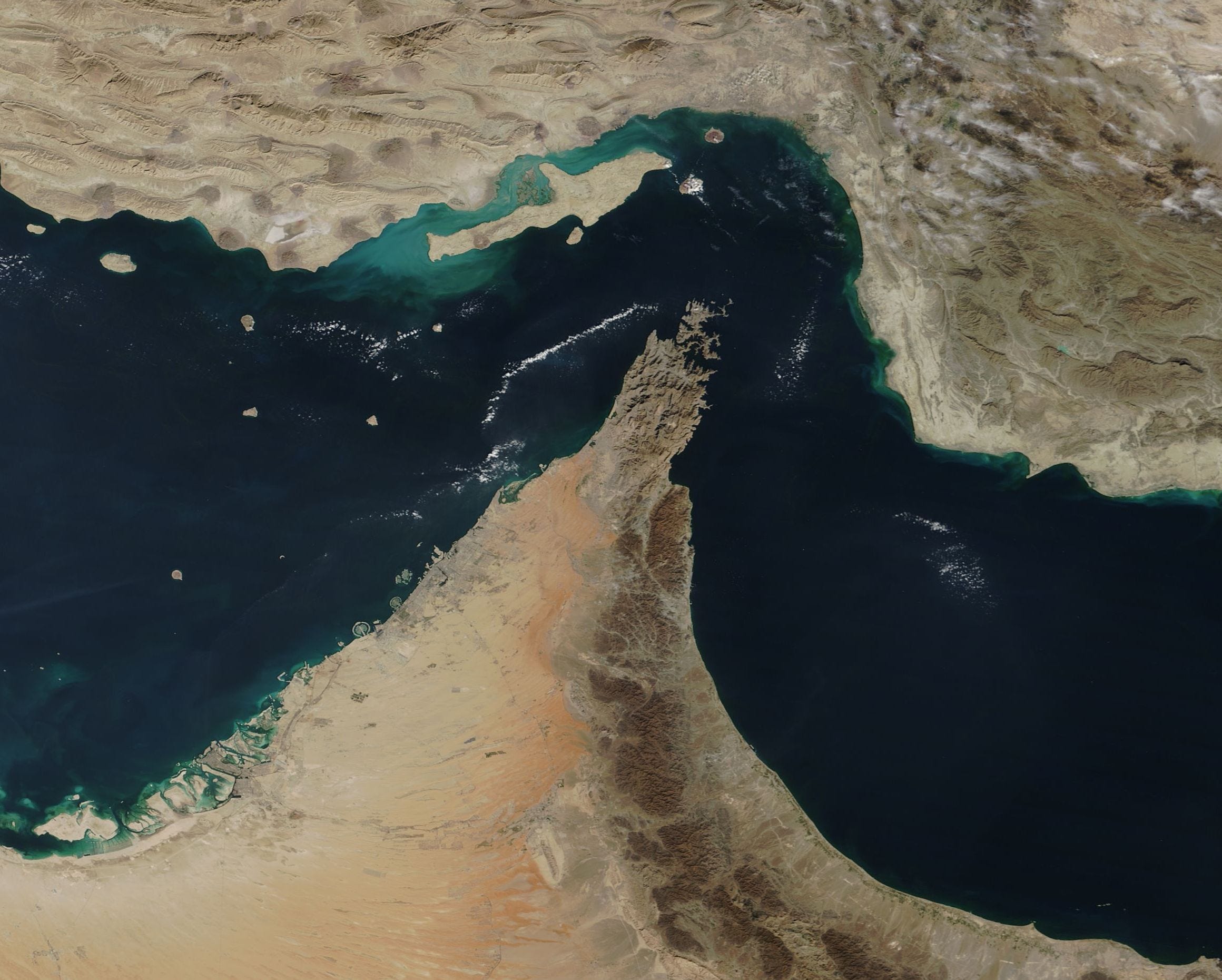
That title immediately set my Spidey Sense to tingling and my fingers to typing https://commons.wikimedia.org/wiki/Main_Page and entering Strait of Hormuz in the search field, only to find out the Strait isn’t straight at all. In fact, it’s bent like a boomerang around the Musandam Peninsula. The only way to get the Strait straight would be to bulldoze Oman and the United Arab Emirates and make the Gulf of Oman and the Persian Gulf one big body of water. Given the history of territorial beefs in the Middle East, I don’t see that sitting very well with folks over there.
Speaking of Straits
None of what I learned about the Iraq attack, the non-straight Strait of Hormuz, or the effects of both on the price of oil helped me with the problem of my oil change. Since I was able to determine the engine in my Trailblazer is a 1.3-liter, turbocharged, inline, three-cylinder powerhouse, cranking out a blistering 155 horsepower, 174–177 lb-ft of torque, and going from 0 to 60 in about 20 minutes, I was also able to determine it requires 4.8 quarts of oil (or 4.5 liters). Why the hell they couldn’t have made it four quarts or five quarts even (or liters, I wouldn’t have cared) is as inexplicable as the reason the Strait of Hormuz isn’t straight. But those things are clearly beyond me.
Given those numbers, I was able to make the following calculations:
With budget synthetic oils selling at $4.99–$6.99 per quart, I’d be able get my oil changed for somewhere between $23.95 and $33.55, plus labor.
With mid-range synthetics at $7–$10 per quart, I’d be looking at $33.60 to $48, plus labor.
Premium synthetics go for $10–$13.99 per quart, which would run me $48 to $67.15, plus labor.
Specialty synthetics for high-performance mills like the one in my Trailblazer can run $15 per quart, which means I’d be looking at $72, plus labor, for an oil change.
Writing all that down, I drove back to the local garage. I showed the mechanic the numbers, told him I’d like to have my oil changed with synthetic oil, and said I didn’t care what grade he used.
“Not so fast, Kemosabe,” the mechanic said.
“Come again?”
“You may not be aware,” quoth he, “your Trailblazer was assembled in Bupyeong-gu, Incheon, South Korea.”
“And that’s relevant because …”
“It’s relevant for two reasons,” the mechanic said. “The good news is Iran hasn’t specifically confirmed whether South Korea is or isn’t allowed to ship through the Strait of Hormuz. That decision is tied up in what’s left of the Guardian Council after the bombings. So, Iran may or may not have a bug up its ass about where your car was made.”
“What’s the bad news?”
“The bad news is any synthetic oil made in other countries of the world can’t go through the Strait if they’re bound for the US. And US brands like ExxonMobil, Valvoline, and AMSOIL are pretty much tapped out. So, you’re SOL.”
“How the hell am I supposed to get around, then, if I can’t get the oil changed in my car?” I asked, getting rather peevish.
“I don’t know,” the mechanic said. “Do you have a motorcycle?”
“I have some good news and some bad news.”
“What’s the good news?” he asked.
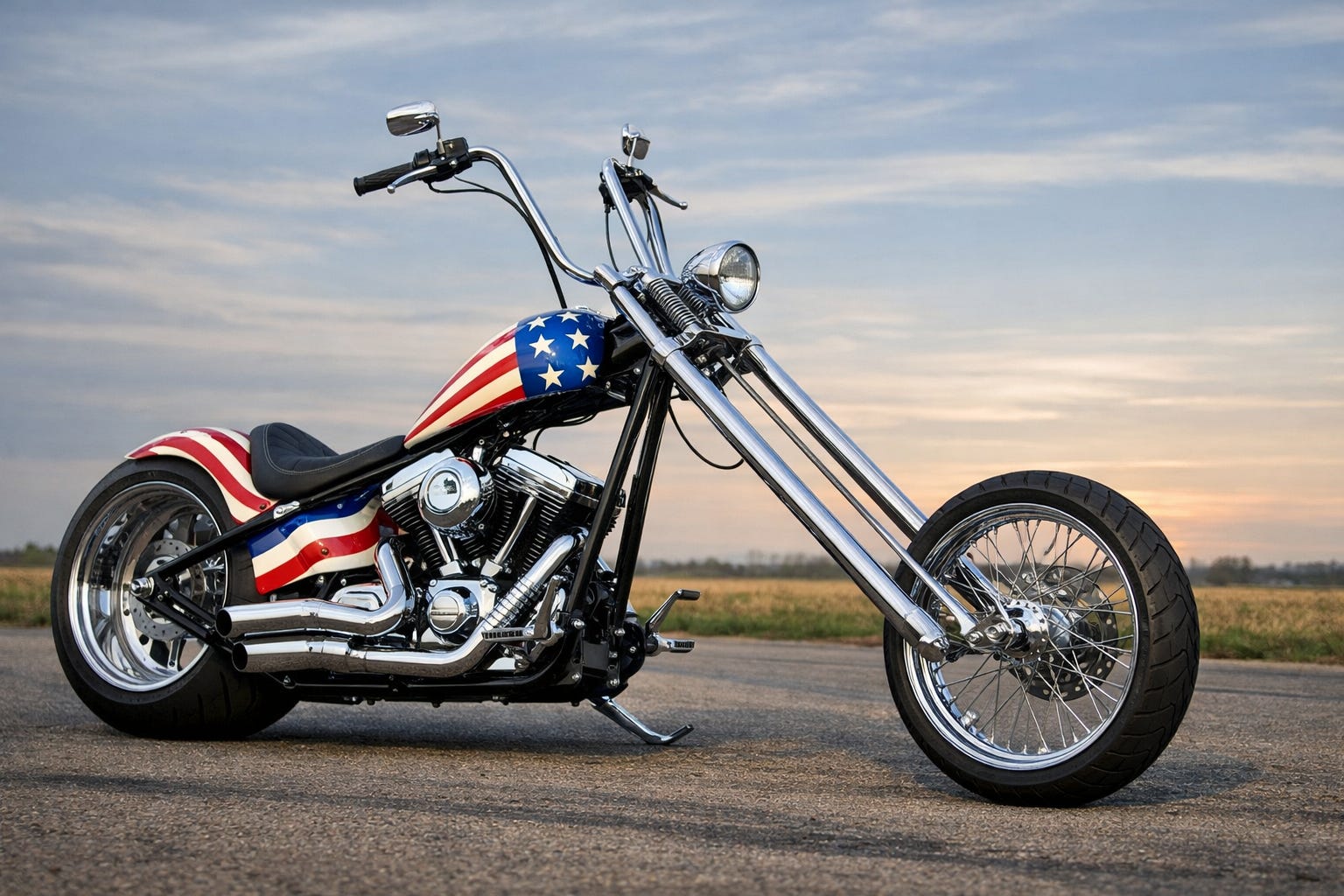
“I have a chopper, made to my specs, with a stretched frame, an increased rake angle, and extended forks. It has ape hangers, a hardtail frame, and an oversized rear wheel, with a custom gas tank and seat, and a stars-and-stripes paint job.
“What’s the bad news?”
Without looking at the mechanic, I said, “It was made in Iran, and it needs parts.”
“Does it need an oil change?” he asked with a smirk.
“Cute,” was all I could say.
Practicality Couldn’t Hurt
I don’t know what opportunities are like to travel or to do business in the Middle East. And while I’m not a big fan of Iran, I trust the authoritarian dictatorship there more than I trust the American Democrat Party because at least Iran doesn’t make any secret of its totalitarian intentions. But all that notwithstanding, I can’t help but wonder if it wouldn’t be globally beneficial if Iran were turned into a parking lot.
Jobs could be created running shuttle services to Bahrain, Cyprus, Egypt, Iraq, Israel, Jordan, Kuwait, Lebanon, Oman, Palestine, Qatar, Saudi Arabia, Syria, Turkey, the United Arab Emirates, and Yemen — to say nothing of Asia, Africa, and Eastern Europe. We’d only have to worry about the occasional suicide bomber and periodic Hamas rocket attacks out of the Gaza Strip. And the only petroleum products that would have to come through the Strait of Hormuz for use in Iran would be asphalt and Jennite.
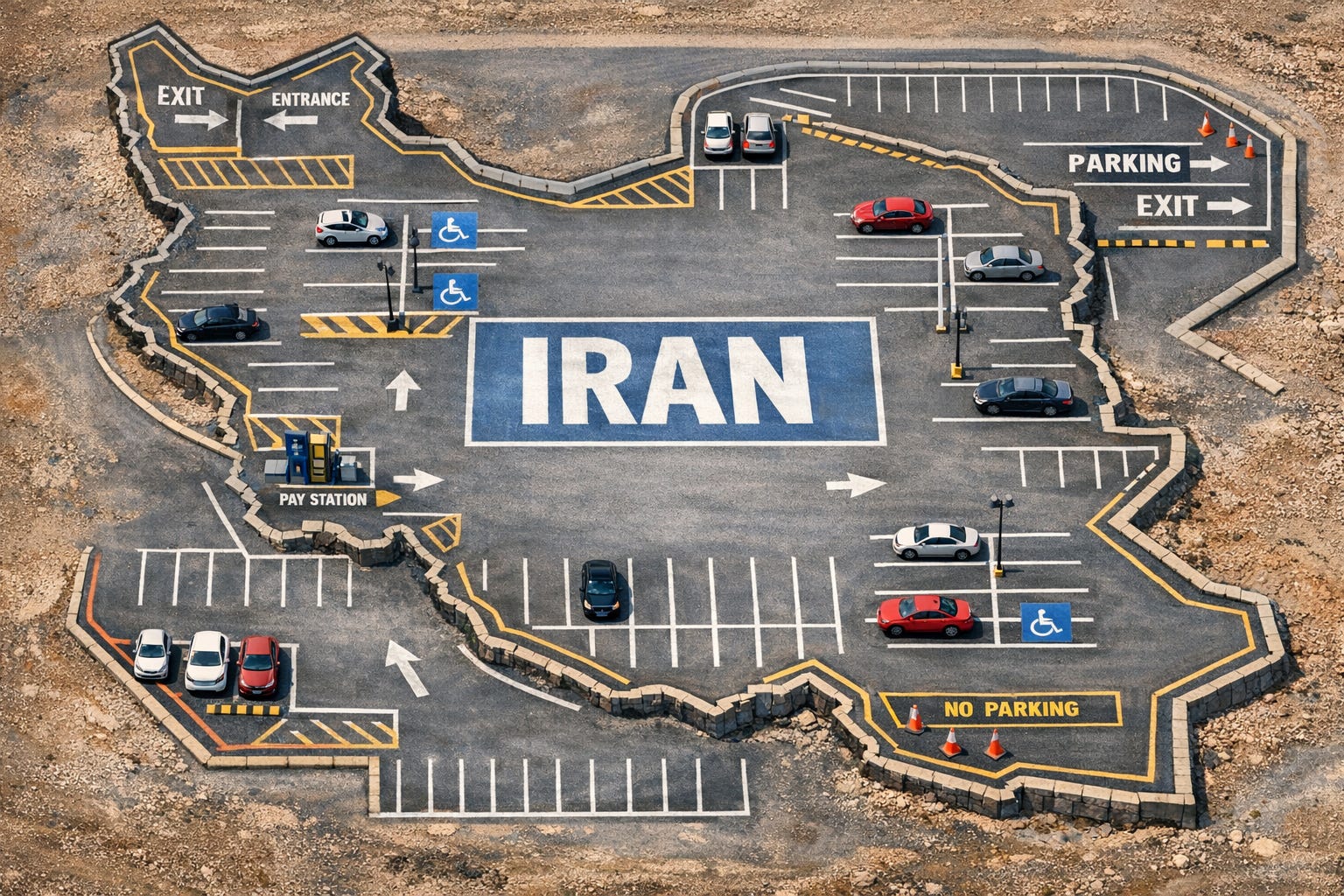
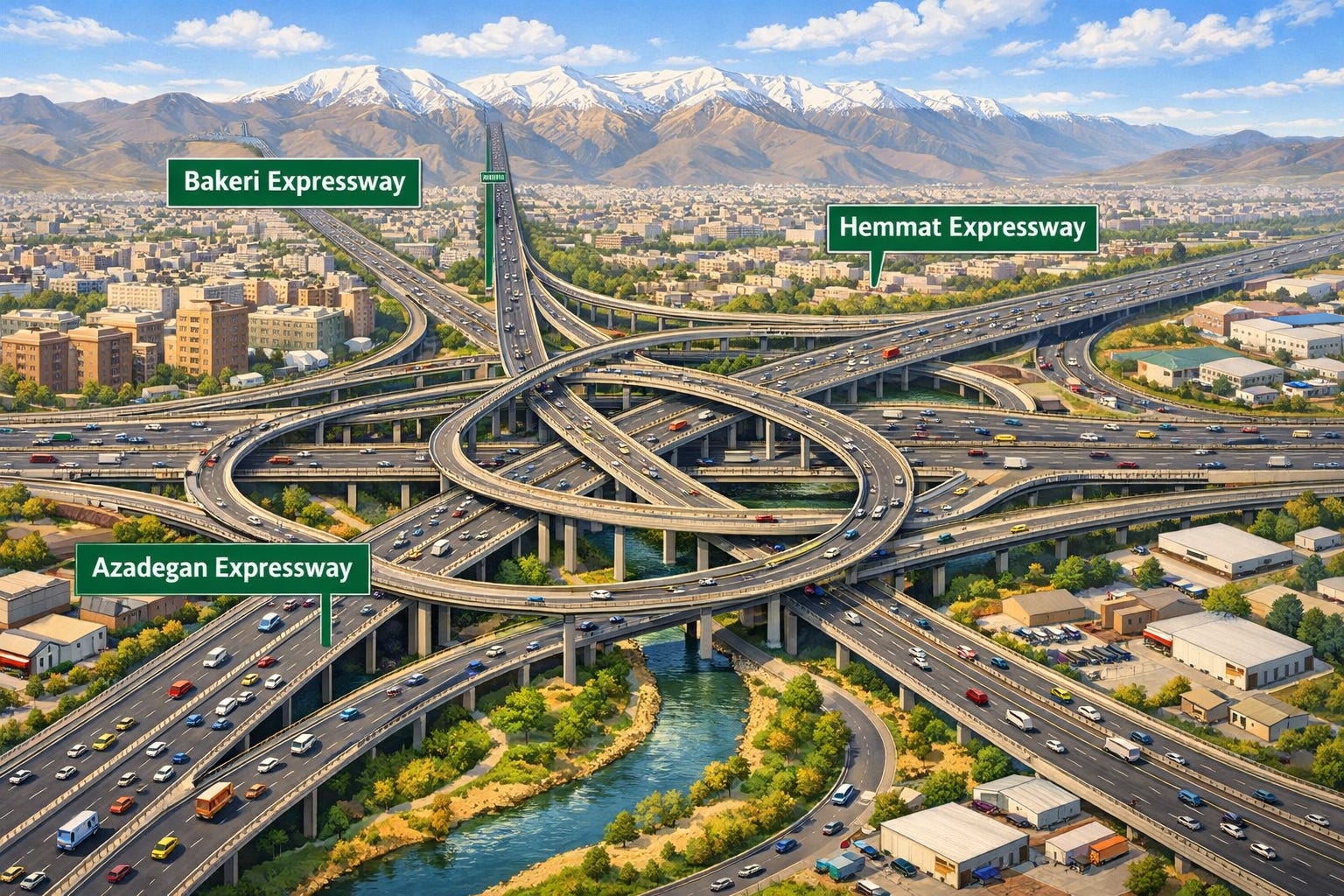
Driving conditions also would be much improved. Getting around in Iran is tough enough without having to worry about parking. In Tehran, for example, driving is chaotic with heavy traffic, especially at typically peak times like 7:00 to 9:00 a.m. and 5:00 to 7:00 p.m. when people driving to or from work at Mash Donald’s, Kabooky Fried Chicken, Pizza Hat, or local nuclear armament plants are distracted by popular talk radio programs like Sticks and Stonings, Hanging Around, Peaceful Protests, and An Arm and a Leg. And roads like the Azadegan, Hemmat, and Bakeri Expressways are perilously congested, with drivers making frequent, aggressive lane changes, making obscene hand gestures (if they still have arms, hands, or fingers), and yelling things like “مادرت کلاههای پاناما میپوشد!” (Translation: Your mother wears Panama hats!)
Time Will Tell
I don’t know if Operation Parking Lot will ever be conducted. Nor do I know if the Strait of Hormuz will ever be straightened out one way or the other. But I do hope something happens relatively soon. While I don’t mind walking, I’d like to get my car and/or my chopper back on the road.
The Shoe Leather Express is getting old.