
Alive on Arrival
or Listen to Your Heart

Author’s Note: This post is adapted from my book, Random Thoughts: A Writer’s Notebook. Unlike some of my other posts in which I refuse to let the truth stand in the way of a good story, every word of this one is true.
I read a story once called, “What Not to Do in a Morgue”, about a British gentleman’s attempt to earn some travel money. It was intended to be funny. But as you might surmise, morgue humor is no laughing matter.
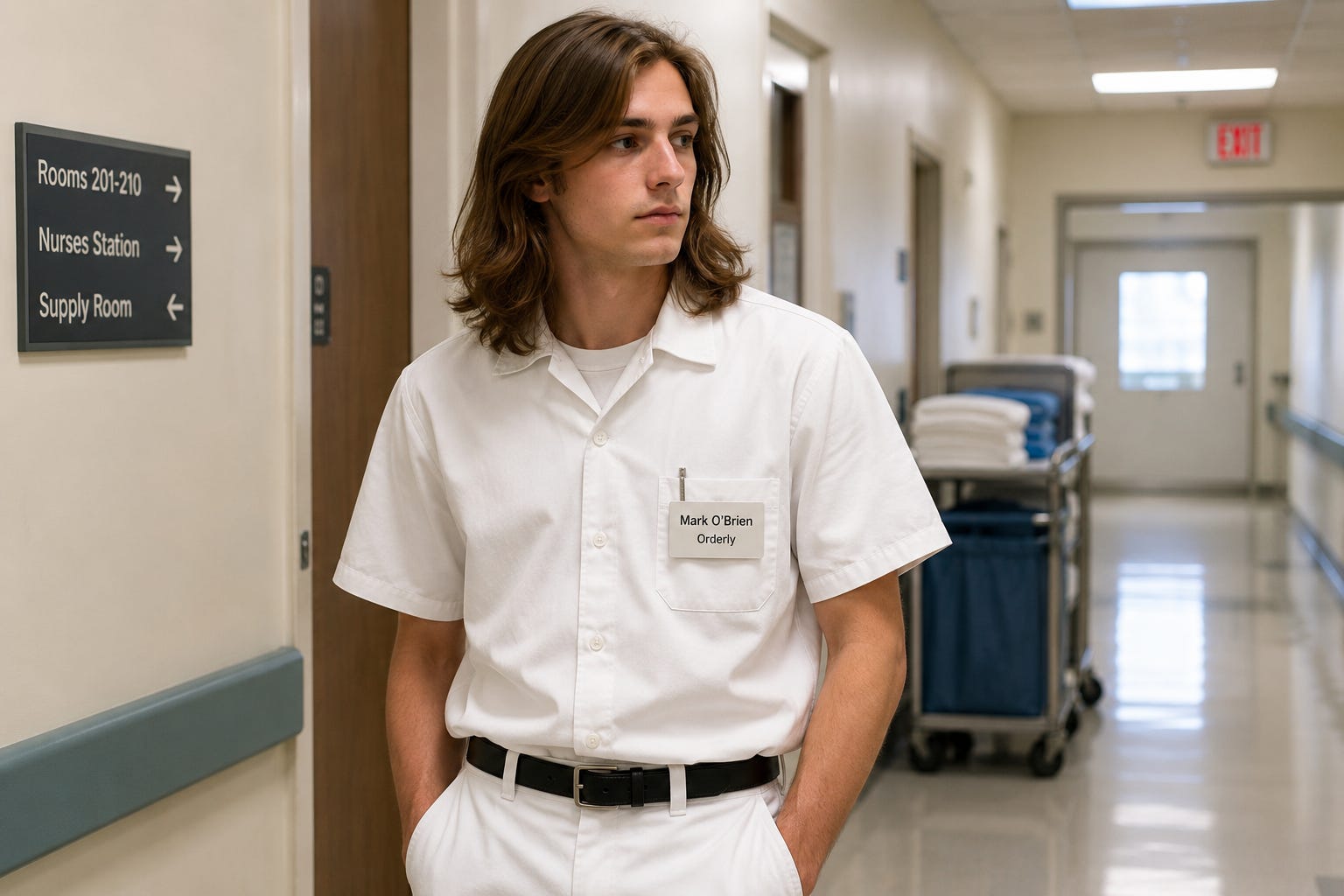
I know because during my first two years out of high school, 1972 and 1973, I was responsible for a morgue. Specifically, I was a house orderly at the now-defunct Meriden-Wallingford Hospital in my hometown of Meriden, Connecticut. House orderly meant anyone anywhere in the hospital who needed help we could provide would have us paged over the hospital intercom system. So, when we heard the page, Eight-Nine-O (890), we’d pick up a phone, call the switchboard (yes, there was still a real switchboard there), and be told where we were needed. And because I worked the day shift — 7:00-3:30 — I was frequently summoned to the morgue.
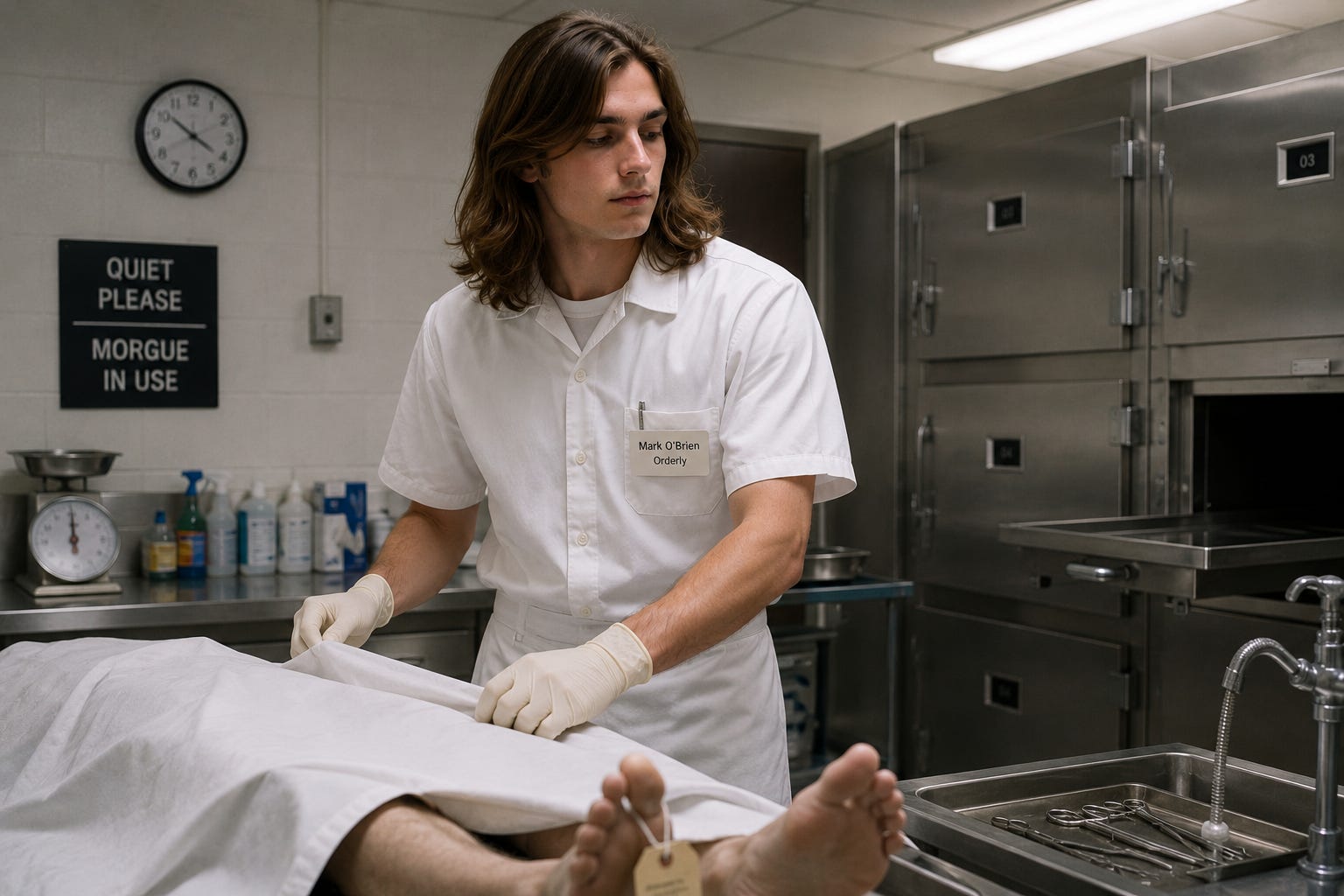
I had a number of morgue-related duties: I had to transport bodies to the morgue — from the patient floors, from the emergency room, from ambulances arriving with DOAs. I had to assist during autopsies for some reason, keeping pathologists company while they took bodies apart searching for or confirming causes of death. I had to help morticians transport bodies from the morgue to their hearses (a task for which they tipped me, always leaving me feeling mercenarily ghoulish).
Sometimes I had to sew up the empty thoracic and abdominal cavities of the bodies if the morticians happened to be particularly meticulous about keeping their body bags and their hearses clean. I survived that task only by pretending to be sewing up a large turkey after it had been properly stuffed.
And I saw much: To help determine if the cause of death was suicide, I had to help the State Police measure the arm of a man — from his shoulder to the second knuckle of his index finger — as well as the shotgun — from barrel-end to trigger — that had blown out his chest. I had to remove the neoprene rope from the neck of an attorney who’d climbed atop a file cabinet and stepped off into eternity.
I had to pull hard-hat shards from the head of a man who’d been in a trench that hadn’t been buttressed with shoring boxes. His skull was as flat as Wile E. Coyote’s after being the victim of his own Acme Anvil. I was once compelled by the State Medical Examiner to weigh the body of a nine-year-old girl whose head had been run over by a school bus. I saw the disintegrated remains of a man who thought standing in front of a train bound from Hartford to New Haven was preferable to carrying on.
For obvious reasons, that job made me wonder two things every day:
What in the world made the people who hired me imagine a boy in his late teens — having taken no aptitude tests, let alone being given preparation or training — was psychologically or emotionally equipped to contend with some of the job’s more grim tasks?
Aside from teaching me I wasn’t cut out for a career in medicine, what in the world could I take from the job that might be of lasting value or meaning for the rest of my life?
Lessons
More than 50 years later, question #1 remains elusively unanswerable. But question #2 answered itself on some transcendent occasions. Here are three:
First, a woman in her 80s, a Mrs. Ruland, whose late husband had been a physician of sufficient renown to have had a clinic named for him at the Masonic Home and Hospital in Wallingford, Connecticut (now Masonicare), was a patient in one of the surgery units. She’d been admitted to have her left eye removed. Every morning of her stay, before and after her surgery, eye patch and all, she got out of bed, made the bed, and dressed herself in her own clothes. Until the day she was discharged, I spent as much time as I could spare in her room sitting, talking, and learning from that gentle, gracious lady.
Second, I was asked (and allowed for reasons I never understood) to give a gentleman suffering from some intestinal malady a soap suds enema. This consisted of filling an IV bag with warm water, dumping a few packets of Castile soap into the water, hanging the IV bag well above the patient, inserting a clamped tube descending from the bag into his rectum, removing the clamp from the tube, and letting gravity do the rest. The patient suffered from cerebral palsy. He was barely ambulatory but managed to get around with two aluminum canes with aluminum cuffs through which he slipped both hands before grabbing the handles of the canes. After taking the entirety of the IV bag’s contents into his colon — and the painfully pressured agitation that water and soap must have caused him — he could have easily evacuated into the bed pan I’d brought into his room. He wouldn’t have it. That man possessed so much fortitude, so much modesty, and so much dignity, he insisted on my handing him his canes so he could walk all the way across the room to the bathroom. When he came out, he asked me why I was crying. Not many of us get to witness that kind of strength and courage.
Third, a gentleman named James J. Barry (I’m sure the date of his passing is wrong in that hyperlink) was admitted after having a severe stroke. Every morning I worked, I’d be called to the Stroke Unit on the sixth floor, lift Mr. Barry into an aluminum-framed chair with nylon webbing for the seat and the back, and wheel him into into a shower room to wash him. When he regained his speech, he’d tell me all he wanted to do was be able to go home to tend his garden. That man worked hard in therapy every day until he was discharged. When he left the hospital, he walked unassisted. One day a few years later, I went to visit my maternal grandmother on Stoddard Drive in Meriden. I happened to glance out the window above her kitchen sink. There, across the street, was Mr. Barry, tending his garden.
Revelations
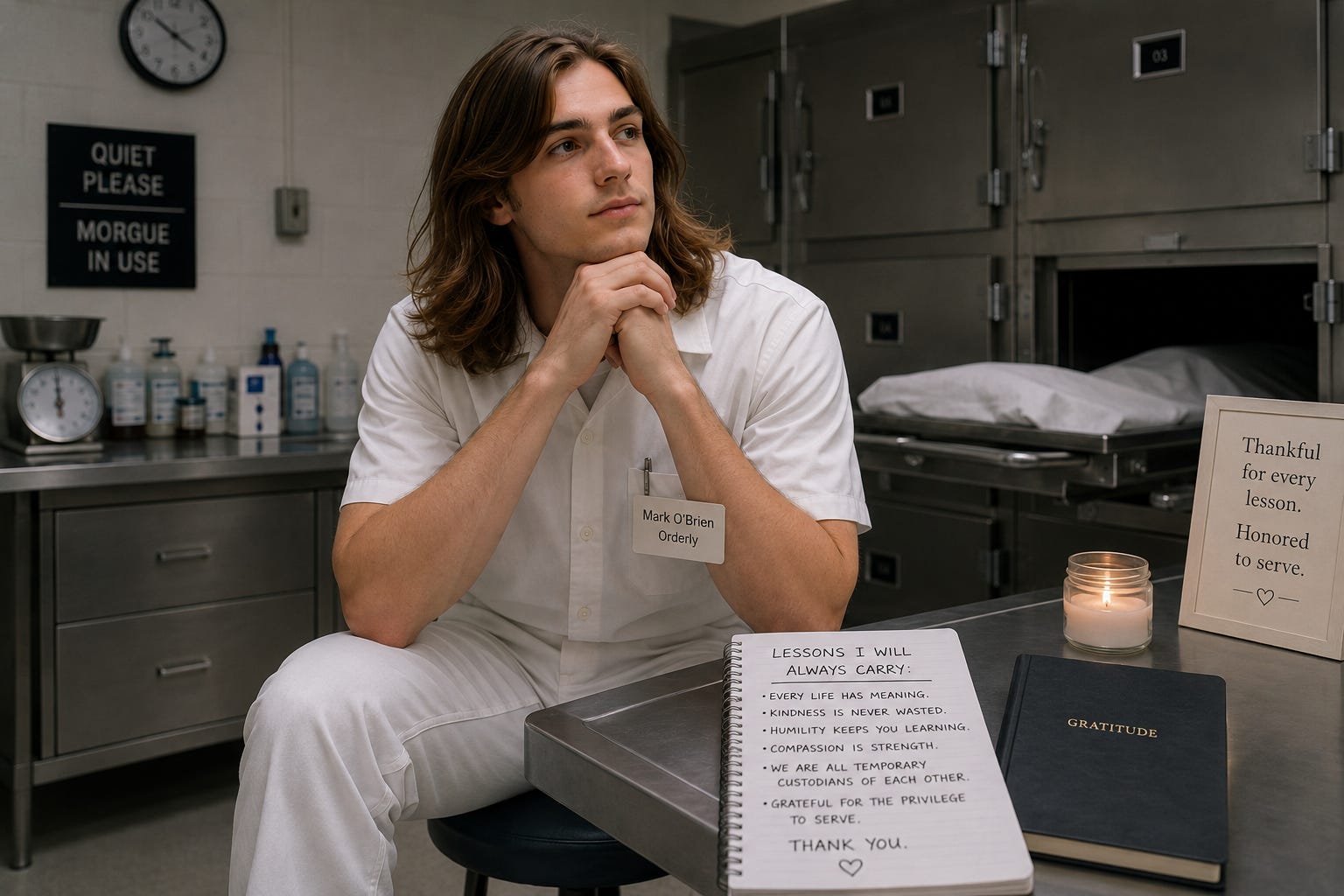
Perhaps informed by my experience in the hospital, question #2 above continues to yield profound lessons. Among them:
Life is short, sometimes brutally so. That tends to make every moment precious and every additional day a treasure.
Loss is universal. But sorrow allows us to witness transcendent grace, the wisdom of acceptance, and the strength to endure.
We control nothing. Knowing that gives us the freedom to celebrate every occasion of joy and to triumph over the shortness of life, to overcome loss and sorrow, and to be free from all illusions of control.
We’re all alive on arrival. What we do after we get here is up to us.
I loved this piece.❤️🩹
A wonderful story, Mark. Such a delicate subject, this fine line between life and death we all live with daily, which most of us ignore and the brave among us embrace with courage and joy. You saw a lot of sadness, but God was kind, balancing that with the human fortitude of Mr. Berry. There are lessons in both. Thank you!